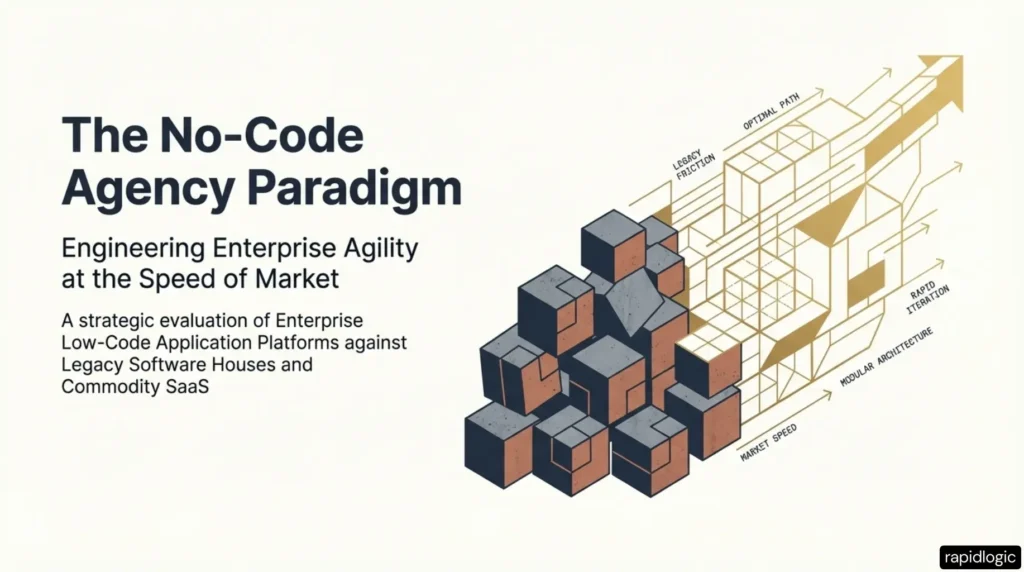
Enterprise organizations face a familiar technology dilemma: SaaS delivers speed but sacrifices flexibility. A traditional software house offers full customization — but at price points and delivery timelines that kill the business case before a single line of code is written. For several years now, the market has offered a third path — dedicated No-Code / Low-Code agencies — that combines the strengths of both worlds while eliminating their fundamental weaknesses. This is not a marketing claim. Gartner projects that by 2026, up to 75% of new enterprise applications will be built using no-code or low-code technologies — a seismic shift in how software is conceived and delivered at scale. Below we outline the five pillars underpinning this strategic advantage.
1. Agile No-Code Technology — Speed That Reshapes Project Timelines
The Market Has Accelerated. Have Your Processes Kept Up?
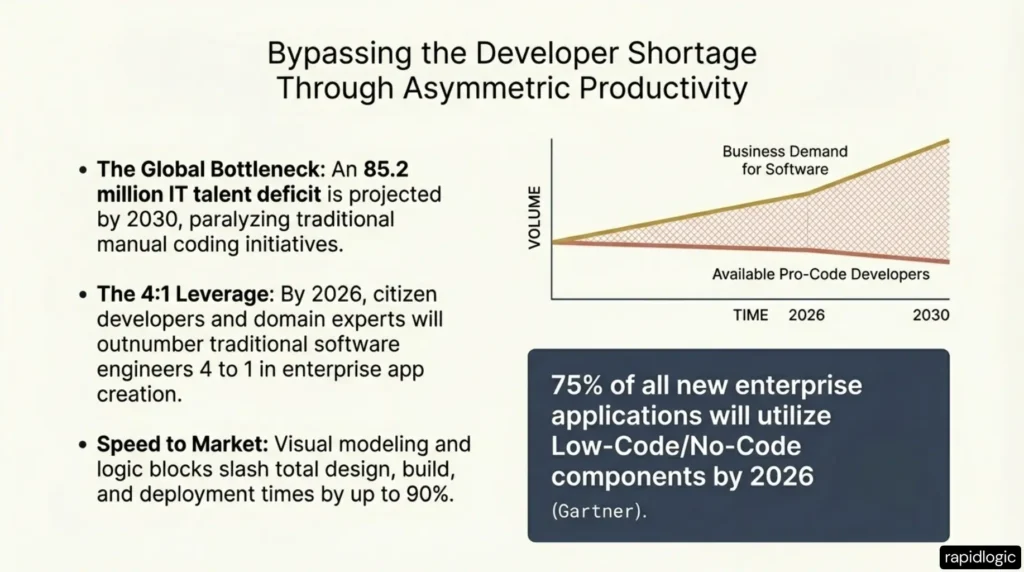
The global shortage of qualified IT professionals is projected to reach 85.2 million unfilled positions by 2030. In this environment, the traditional model of building software through hand-written code is becoming operationally unsustainable. No-Code platforms directly address this structural gap: according to Gartner, the ratio of citizen developers to professional developers will reach 4:1 by 2025. The global Low-Code Application Platform (LCAP) market — valued at $24.83 billion in 2023 — is expanding at a CAGR of 22.5% and is forecast to surpass $65 billion by 2030. This is not a niche trend; it is the mainstream trajectory of enterprise IT.
Delivery Times Cut by Up to 90% — What Does That Mean for Your IT Backlog?
Modern enterprise-grade platforms such as Bubble.io meet the strictest security requirements out of the box: SOC 2 Type II, GDPR, and HIPAA compliance are built into the infrastructure — not sold as expensive add-ons. Dedicated Enterprise plans offer contractually guaranteed SLAs of 99.99% uptime, 24/7 support, and automatic database scaling to handle sudden traffic spikes without manual intervention. The business impact is measurable: 85% of enterprise deployments on the Bubble platform generate savings of $300,000–$1,000,000 per year through accelerated software delivery cycles.
2. Reusable Components and Headless Architecture — Pay for Unique Value, Not Boilerplate
The Leverage Effect — Component Libraries as a Competitive Technical Asset
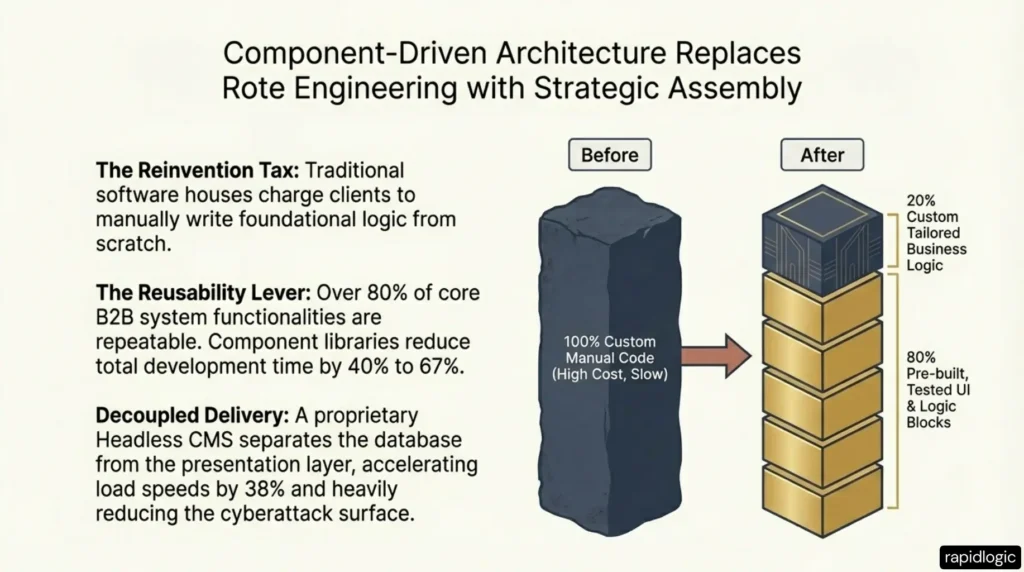
A traditional software house writes over 80% of base functionality — authentication, role management, admin panels, API integrations — from scratch for every single client engagement. A specialized No-Code agency delivers those capabilities as rigorously tested, production-ready modules. Research from NIST confirms that organizations leveraging standardized component libraries reduce total development time by 40%. Specialized design firms report UI development time reductions of 60–67%. For the Enterprise client, this means paying exclusively for business logic that is genuinely unique to their organization — not subsidizing the reinvention of the wheel on every project.
Headless CMS Architecture — Performance, Security, and Freedom from Vendor Lock-in
A Headless CMS fully decouples the presentation layer from the data layer — content is delivered exclusively through secure APIs. The same data can simultaneously power a web portal, a mobile app, ERP integrations, and IoT devices without redundant development effort. Applications built on this architecture load an average of 38% faster than traditional monolithic CMS platforms. Separating the database from the client layer also drastically reduces the attack surface — a key argument for any CISO. Equally important: the No-Code agency’s license includes the right to modify and fork all business logic, completely eliminating vendor lock-in risk. If the organization decides to bring development in-house or switch partners in the future, it retains full, legally guaranteed rights to do so.
3. The True Cost of SaaS — Why the Easy Path Is Often the Expensive One
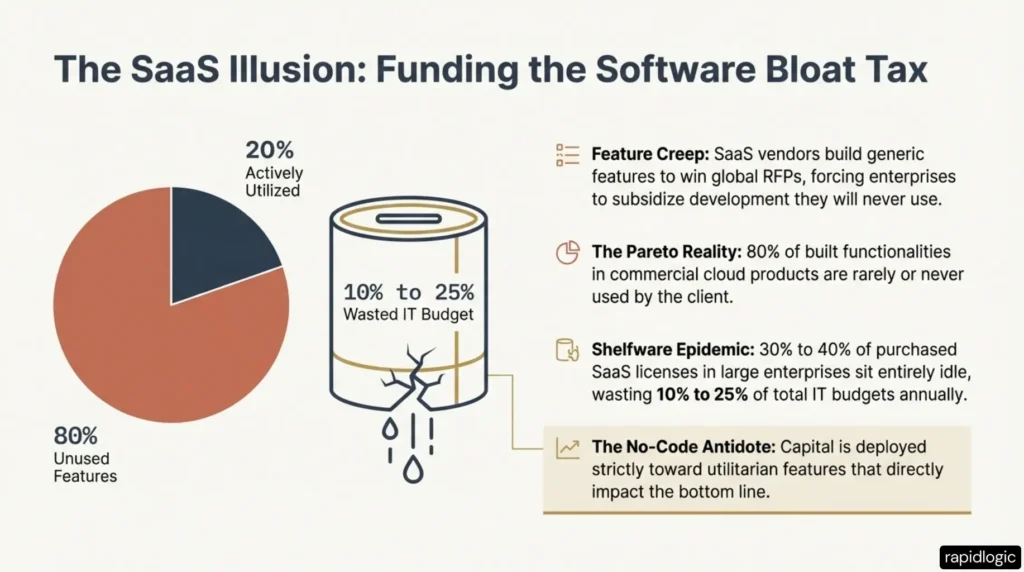
Software Bloat — You Are Funding Features You Will Never Use
SaaS vendors build products for the broadest possible market. The inevitable result is software bloat — feature-heavy systems where complexity becomes a liability. Research by Pendo demonstrates that 80% of features in the average SaaS product are used rarely or never. Inside large enterprises, the waste compounds further: between 30% and 40% of paid SaaS licenses go completely unused — a phenomenon known as shelfware. IT leaders estimate that 10–25% of total software budgets are wasted annually on inactive subscriptions. A purpose-built No-Code application contains only the functionality your organization actually needs — no digital dead weight, no license fees for features gathering dust.
Vendor Lock-in, Process Debt, and Multi-Tenant Security Risk
The lack of flexibility in SaaS has a measurable cost: 60% of enterprise software users struggle with irresolvable integration issues, and 47% cite insufficient customization as their primary source of professional frustration (Forrester). Implementing a change required by the business depends entirely on the global vendor’s product roadmap — wait times routinely stretch from months to years. With a No-Code architecture, the same change is deployed in days.
The security dimension is equally critical. The vast majority of SaaS platforms operate on a multi-tenant architecture — your organization’s data (client lists, financial records, employee information) shares physical infrastructure with thousands of other tenants, including direct competitors. A dedicated No-Code application deployed on an Enterprise Single-tenant plan provides full physical resource isolation and complete audit transparency. Industry research is unambiguous: the five-year ROI of dedicated solutions stands at 55%, compared to 42% for SaaS deployments.
4. Lower Rates, Higher Output — The Math That Convinces CFOs
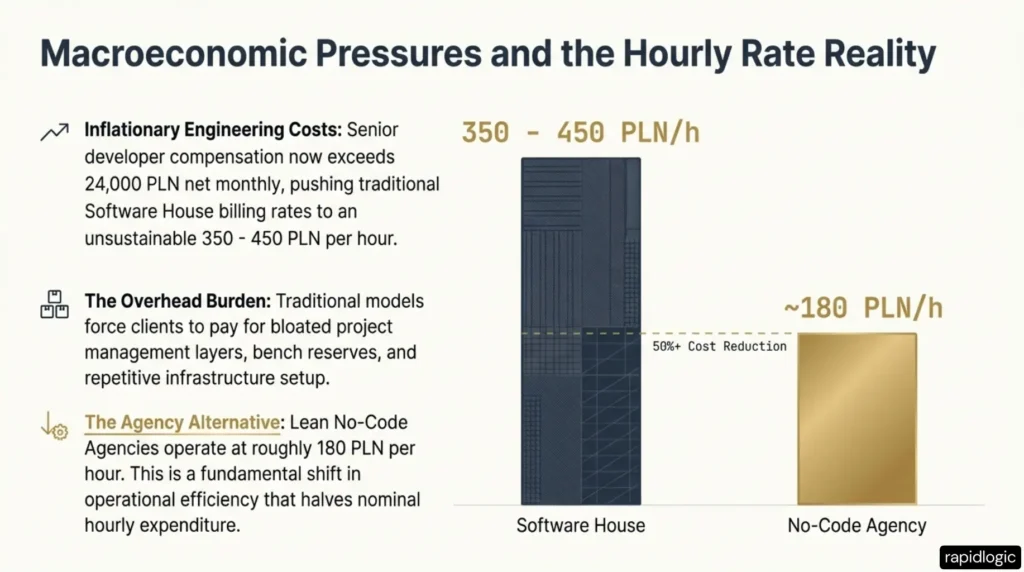
Senior developers in the Polish IT market command over PLN 24,000 net per month on B2B contracts, which translates directly into software house invoices of PLN 350–450 per hour. In a Time & Materials billing model — where hundreds of hours are consumed writing repetitive boilerplate code — the total cost of a standard project escalates rapidly into the hundreds of thousands.
A No-Code agency operates in a fundamentally different mathematical category. The hourly rate is nominally over 50% lower, but the real transformation lies in output asymmetry: the same application is delivered in a fraction of the time, because the No-Code developer configures battle-tested modules rather than writing from scratch. Aggregated deployment data from enterprise LCAP platforms points to possible reductions in delivery time of up to 90%.
| Delivery Model | Rate / Timeline | Estimated Project Cost |
|---|---|---|
| Monolithic Software House | PLN 350–450/h × ~1,000 h | PLN 350,000–450,000 |
| Subscription SaaS | Low upfront Capex (apparent) | Rapidly escalating per-user monthly fees |
| No-Code Agency ★ | ~PLN 180/h × ~200 h (reusable modules) | ~PLN 36,000 (often 10× cheaper) |
* Indicative benchmarks based on market research reports 2024–2025. Actual costs vary by project complexity.
The No-Code approach does not diminish the intellectual value of a software engagement. It redirects engineering energy away from repetitive coding toward creative problem-solving on the most complex business challenges the client faces. Frozen IT budget is unlocked and redeployed toward the next wave of digital initiatives.
5. The Snowball Effect — Savings Reinvested Drive Continuous Improvement
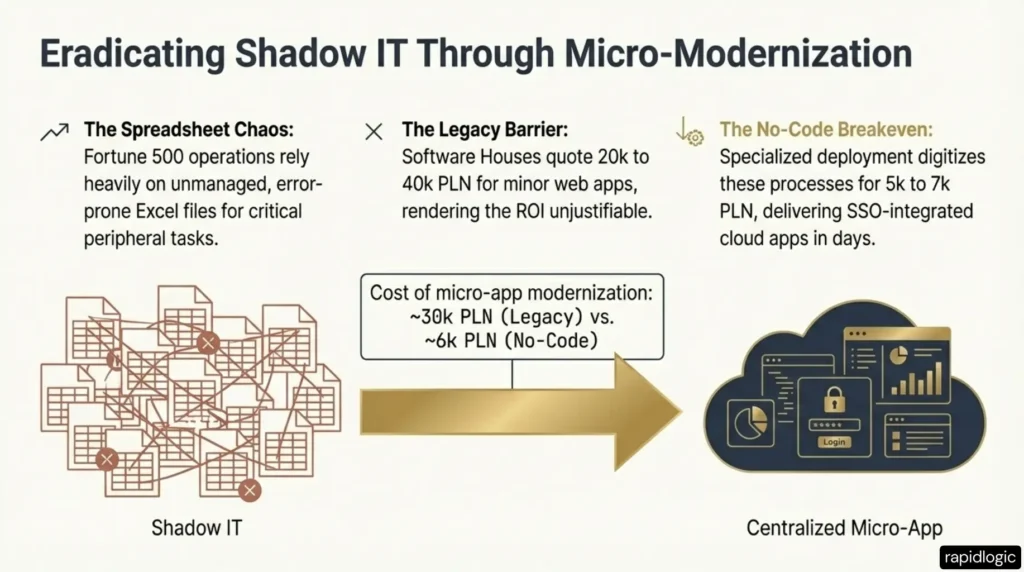
The Economics of Micro-Modernization — Replace Excel with an App for PLN 5,000–7,000
Most mature Enterprise organizations carry hundreds of mission-critical processes running on uncontrolled spreadsheets — from procurement management and HR document workflows to financial reporting. In the traditional software house model, digitizing a single such process was quoted at PLN 20,000–40,000 — making the business case structurally negative from the outset. A No-Code agency delivers the same modernization for PLN 5,000–7,000, including integration with Active Directory and SSO. The breakeven point arrives almost immediately after go-live, as organizations eliminate tens of thousands of manual working hours annually through automated data capture and error prevention.
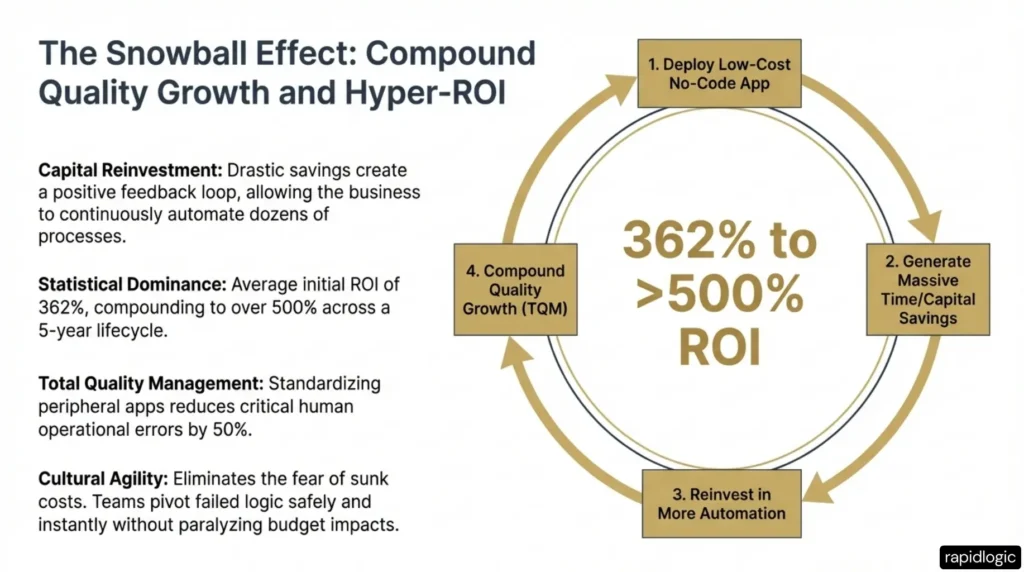
Compound Quality Growth — The Positive Feedback Loop
The snowball starts rolling with the first deployment. IDC research shows that the average ROI of low-code platform deployments reaches 362%, and exceeds 500% over a five-year horizon. No-Code implementations reduce the frequency of human errors in operational processes by 50%. The mechanism is straightforward: digitizing process A generates savings that fund the automation of process B. Each iteration raises data quality, reduces manual labor, and frees specialists to focus on high-value work. The organization builds a genuine culture of agility in which every innovation initiative carries a realistic, short payback period — free from the risk of sunk costs that characterize traditional software house projects.
Key outcomes for Enterprise organizations:
- Application deployment replacing spreadsheets in 2–3 weeks rather than 6–9 months
- Five-year ROI exceeding 500% (IDC)
- 50% reduction in human error rates across operational processes
- Specialists freed from administrative overhead to focus on strategic initiatives
- IT budget reinvested iteratively — no single multi-million-dollar project bets
Strategic Conclusion
A No-Code agency is not a cheaper version of a software house, nor a more flexible SaaS. It represents a fundamentally different architectural model — one that reconciles what was previously irreconcilable: deployment speed without surrendering control over business logic, the flexibility of bespoke software without the cost of a traditional software house, and enterprise-grade security and scalability without the risk of ecosystem lock-in.
For an Enterprise purchasing committee, this translates into a concrete, measurable decision. A real example from our portfolio: Tidly.pl is a marketplace platform featuring full booking logic, a vendor panel, and payment integrations. A traditional software house quoted the project at PLN 100,000–150,000 with a 5–7 month delivery timeline. RapidLogic delivered it for PLN 35,000–50,000 in 6–8 weeks. Cost ratio: approximately 3:1 at comparable end quality. The savings do not sit idle — they are reinvested in the next automation, generating the next return. That is the snowball effect in practice: each investment accelerates the mechanism that drives the next.
Organizations that adopted this model earlier are today reinvesting their recovered IT budgets into further competitive advantages, while their peers still await the completion of software house projects scoped two years ago. In digital transformation, time is the scarcest resource. No-Code technology is currently the only proven, scalable method to systematically reclaim it.