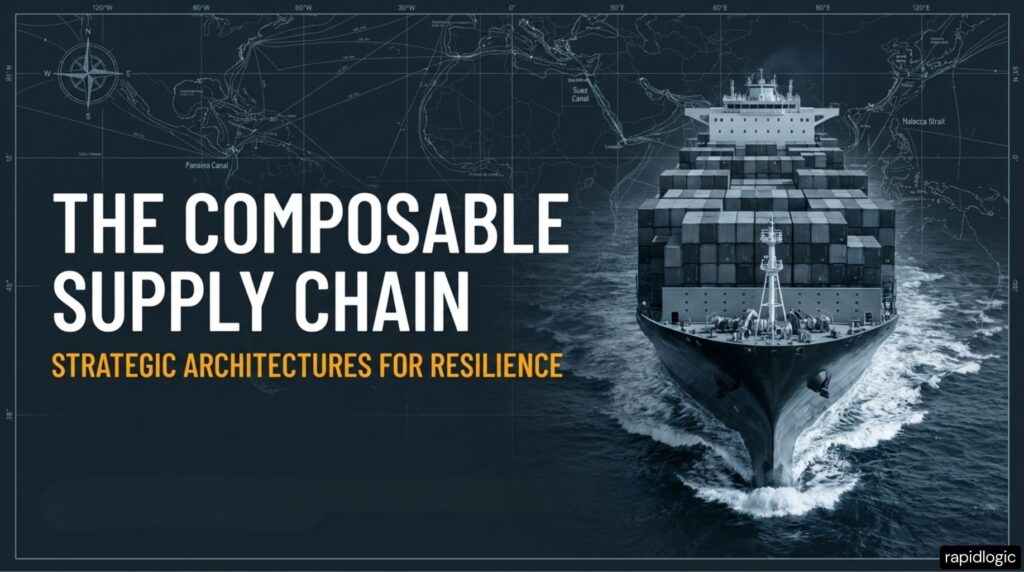
By 2025, LCNC platforms are projected to underpin over 65% of all enterprise application development activity (Gartner). For the TSL sector – where 60-80% of IT budgets are consumed by maintaining aging legacy systems – this is not a trend to monitor. It is an operational imperative.
The Transport, Shipping, and Logistics (TSL) industry faces a defining choice: remain locked in a cycle of legacy ERP, WMS, and TMS debt while competing for scarce development talent – or embrace a third path. Low-Code/No-Code (LCNC) platforms, once dismissed as departmental tools for HR forms, are now certified by Gartner and deployed by global logistics leaders to architect resilient, composable enterprises. This article examines why LCNC has become a boardroom-level strategic imperative – not merely an IT option.
1. The Technical Debt Trap – Why the Status Quo Is Destroying Competitiveness
1.1 IT Budgets Paralyzed by Legacy Maintenance
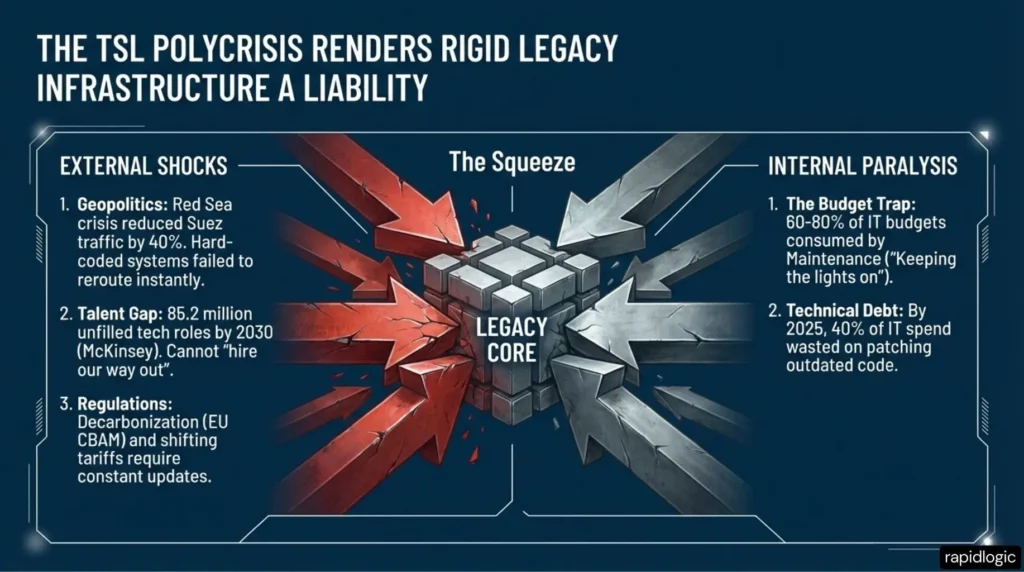
The logistics sector has chronically underinvested in digital transformation relative to finance and retail. The consequence is structural: TSL companies now allocate between 60% and 80% of their IT budgets solely to keeping legacy systems operational – what practitioners call ‘keeping the lights on.’ Research estimates that by 2025, technical debt alone will consume 40% of IT spending across the industry.
Many organizations attempt to break this cycle through ‘Big Bang’ digital transformation programs – wholesale system replacements. The data is unambiguous: 70% of such projects fail to achieve their objectives, and multi-year timelines routinely outlast the market conditions they were designed to address.
1.2 Islands of Information and the Talent Gap – Two Sides of the Same Crisis
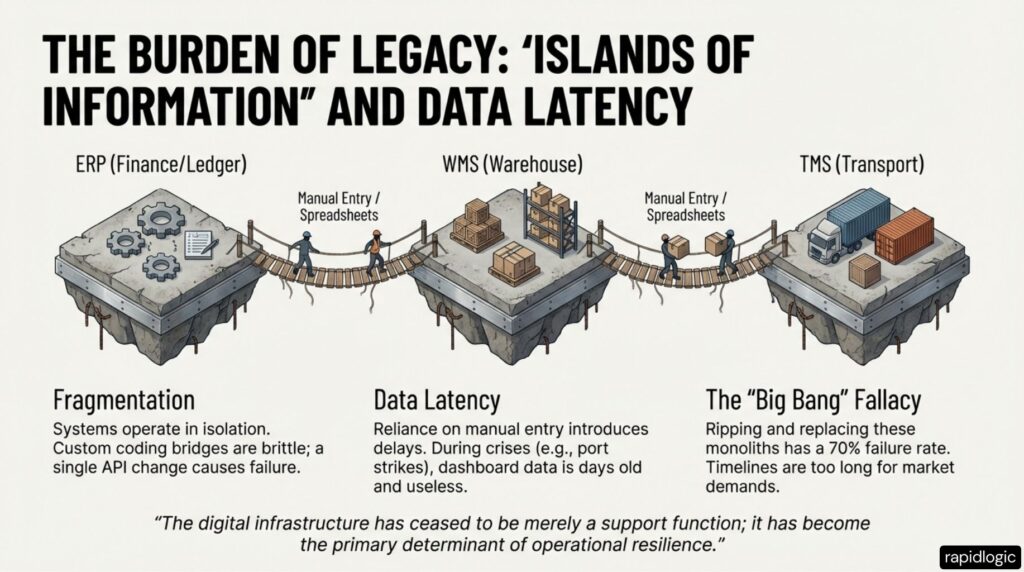
Traditional TSL architectures are defined by fragmentation. A Warehouse Management System (WMS) operates in isolation from the Transportation Management System (TMS), which is itself disconnected from the ERP. In a crisis scenario – a port strike, a geopolitical rerouting such as the Red Sea disruption – the lag between an event occurring and appearing in a decision-making system can stretch to days, rendering the data operationally useless.
In parallel, a global talent crisis is making custom development increasingly untenable. McKinsey reports a shortage of 40 million technology professionals in 2021, projected to reach 85.2 million unfilled roles by 2030. TSL companies cannot match the compensation and career prestige of pure-play tech firms, making it structurally impossible to hire enough developers to clear the IT backlog through traditional means.
2. Understanding LCNC – Why Enterprise Leaders Are Taking It Seriously
2.1 From Departmental Forms to Mission-Critical Infrastructure: The LCNC Evolution
The definition of LCNC has matured fundamentally over the past five years. The conversation has shifted from simple drag-and-drop form builders to Enterprise Low-Code Application Platforms (LCAP) – capable of handling mission-critical workloads, complex integrations, and AI orchestration at scale. Gartner’s 2025 Magic Quadrant for Enterprise LCAP positions Mendix, OutSystems, and Microsoft Power Platform as undisputed Leaders. Forrester’s 2025 report confirms that LCNC has become the primary vehicle for delivering AI use cases within enterprise IT organizations.
The critical distinction: No-Code targets business users (the ‘Citizen Developer’) through entirely visual drag-and-drop interfaces – ideal for departmental workflows and data collection apps. Low-Code is built for professional developers who can inject custom code (JavaScript, Python, C#) for complex logic, integrations, and UI customization. Together, they form a unified development spectrum that serves the full enterprise.
2.2 The Composable Architecture – A New Blueprint for TSL Systems
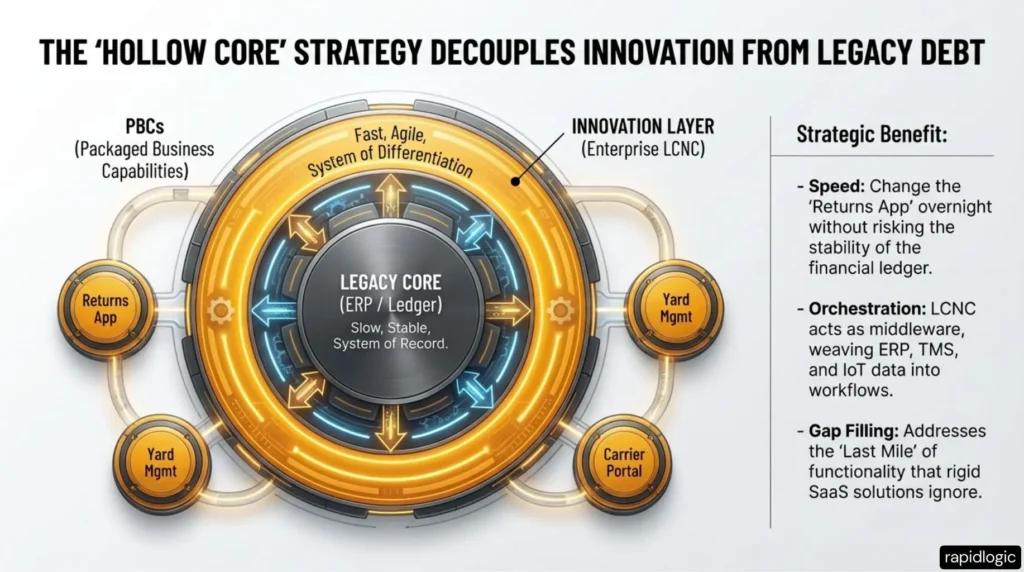
LCNC is the technical foundation of the ‘Composable Enterprise.’ This architectural philosophy rejects the monolithic ‘one system to rule them all’ paradigm. Instead, TSL companies build an ecosystem of focused micro-applications – Packaged Business Capabilities (PBCs) – each solving a discrete operational problem: a returns processing app, a yard management utility, a hazardous materials compliance checker.
“We can update the returns application overnight without touching a single line of the ERP’s financial ledger.” – Composition logic replaces dependency logic.
These micro-apps sit alongside the legacy data core, communicating via APIs. The LCNC platform acts as the orchestration layer – weaving together data from ERP, TMS, and IoT sensors into coherent workflows. Organizations gain the ability to modify operational logic in hours, without destabilizing the transactional systems the business depends on.
3. The Economic Case: ROI, TCO, and Speed
3.1 A Three-Way Comparison: The TSL Technology Decision Framework
| Criterion | Custom Development | SaaS (COTS) | Low-Code / No-Code |
|---|---|---|---|
| Upfront Cost (CapEx) | High – specialized labor, long timelines, infrastructure setup | Low/Medium – subscription-based, minimal configuration | Medium – platform license + reduced dev time |
| Time to Market | Slow – 6 to 18 months for an MVP | Fast – immediate deployment, configuration-dependent | Very Fast – weeks to months; 40-50% faster than custom |
| Customization | Unlimited – 100% fit to business process | Limited – configuration only, ‘vanilla’ processes | High – 80-90% fit with speed; extensible logic |
| TCO (Maintenance) | High – technical debt, security patches, code rot | Low – vendor-managed upgrades | Low/Medium – platform-managed infrastructure; logic only |
| Talent Requirement | High – Senior Full-Stack, DevOps, Architects | Low – Admin/Business Analyst | Medium – Citizen Devs + IT Pros; lower barrier to entry |
| Integration Agility | Complex – custom API maintenance, brittle connections | Variable – vendor ecosystem dependent | High – pre-built connectors; API-first design |
| Innovation Cycle | Slow – rigid release cycles, regression risk | Vendor roadmap-dependent – wait for features | Continuous – iterative, agile, daily deployments |
3.2 Quantified Results from Real-World LCNC Deployments in Logistics
The business case for LCNC is not theoretical – it is grounded in documented, measurable outcomes:
- 40% reduction in time-to-market for new applications – Toll Group (150 countries, 20,000+ customers) using the Mendix platform
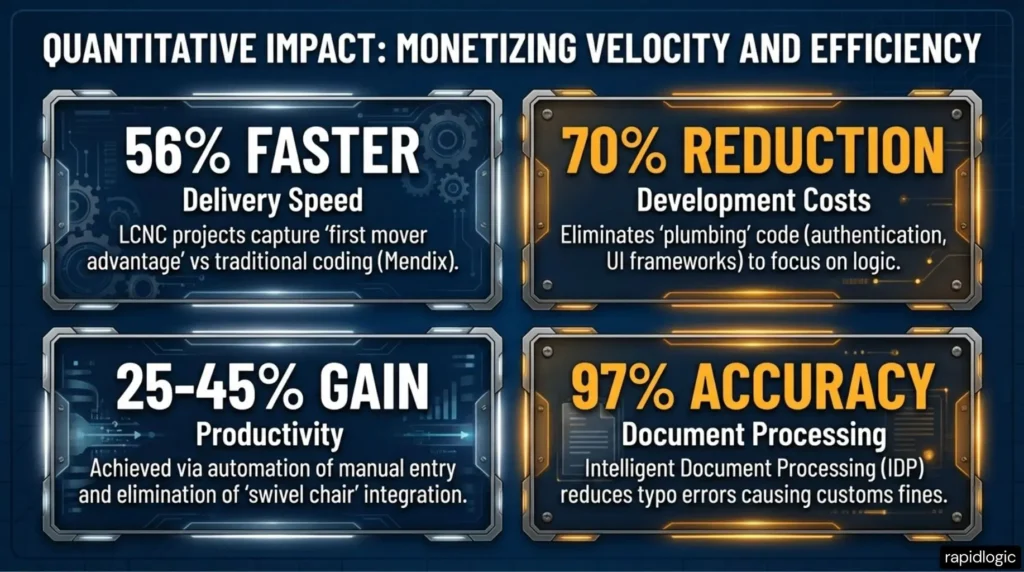
- 56% faster delivery than traditional development methods (Mendix survey data)
- 70% reduction in development costs vs. custom coding
- 55% improvement in order processing speed following low-code workflow deployment
- 25-45% increase in employee productivity through elimination of manual data re-entry
- 97% data extraction accuracy in LCNC-based Intelligent Document Processing (IDP) systems
The Toll Group case study is definitive. One of the world’s largest integrated logistics providers chose not to replace its core systems. Instead, it adopted a Low-Code Modernization Strategy with Mendix – building multiple value-added operational applications within 12 months. The transformative outcome: Toll could respond to customer RFPs with working digital prototypes, not slide decks.
4. Five High-Impact LCNC Use Cases in TSL
4.1 The ‘Hollow’ WMS – Modernization Without Replacement
A new WMS implementation costs millions and takes 18-24 months. Rather than this high-risk replacement, organizations are using LCNC to build targeted modules – returns management, kitting, hazardous materials handling, RFID integration – that connect directly to the existing ERP. When a new product line requires an additional quality check, the ‘Goods-In Application’ can be updated in hours, without touching the legacy system’s source code.
4.2 Supply Chain Control Towers and Real-Time Visibility
The Red Sea crisis – which reduced Suez Canal traffic by 40% – exposed the fatal rigidity of hard-coded logistics systems. Organizations with composable architectures could rapidly deploy crisis management applications: ingesting real-time vessel location data, recalculating ETAs based on the Cape of Good Hope routing, and automatically triggering customer notifications. Rather than waiting months for a vendor patch, a low-code team builds a Surcharge Calculator in days – protecting revenue in real time.
4.3 Intelligent Document Processing (IDP) and Regulatory Compliance
Logistics is inherently document-intensive: Bills of Lading, commercial invoices, customs declarations, Proofs of Delivery. LCNC combined with AI (Intelligent Document Processing) automates the ingestion, classification, and extraction of data from these documents, reducing processing labor costs by over 50%. Critically, LCNC applications can be updated within days to reflect new regulatory requirements – such as the EU’s Carbon Border Adjustment Mechanism (CBAM) mandating emissions data on invoices.
4.4 Amazon-Class Customer and Supplier Portals
Enterprise customers now expect Amazon-level shipment visibility, but legacy systems rarely support external-facing interfaces. LCNC enables the rapid development of branded, self-service portals – fully integrated with backend logic, not generic SaaS portals carrying a vendor’s brand. Toll Group executed precisely this strategy, building a ‘Quote and Book’ service and Global Forwarding APIs on a low-code layer – delivering a modern digital face to customers while leaving the backend engine untouched.
4.5 Crisis Response – Agility Where Rigid Systems Fail
Route changes, new tariff structures, sudden regulatory shifts – legacy systems cannot adapt at market speed. Organizations with LCNC platforms deploy crisis responses in days, not months. In a high-stakes, low-margin industry, this is not a convenience – it is the difference between retaining clients and losing them permanently.
5. From Decision to Scale – A Roadmap for TSL Leaders
5.1 Governance and the Center of Excellence – Avoiding the Shadow IT Trap
Democratizing development introduces real risk: Shadow IT, data leakage, and ungoverned technical debt. Organizations scaling LCNC successfully establish a Center of Excellence (CoE) – a cross-functional team that defines standards, selects platforms, and provides training. Gartner advocates for ‘Fusion Teams’ – mixed IT and operations groups that validate applications in real operational contexts before deployment.
- Simple applications (lunch ordering, shift sign-off): citizen developers build and deploy autonomously
- Departmental applications (fleet tracking, shift scheduling): require peer review and IT sign-off
- Mission-critical applications (hazardous materials routing, core TMS logic): must be built or certified by professional developers within the LCNC environment
5.2 The 2025-2030 Horizon: LCNC as the Orchestration Layer for Agentic AI
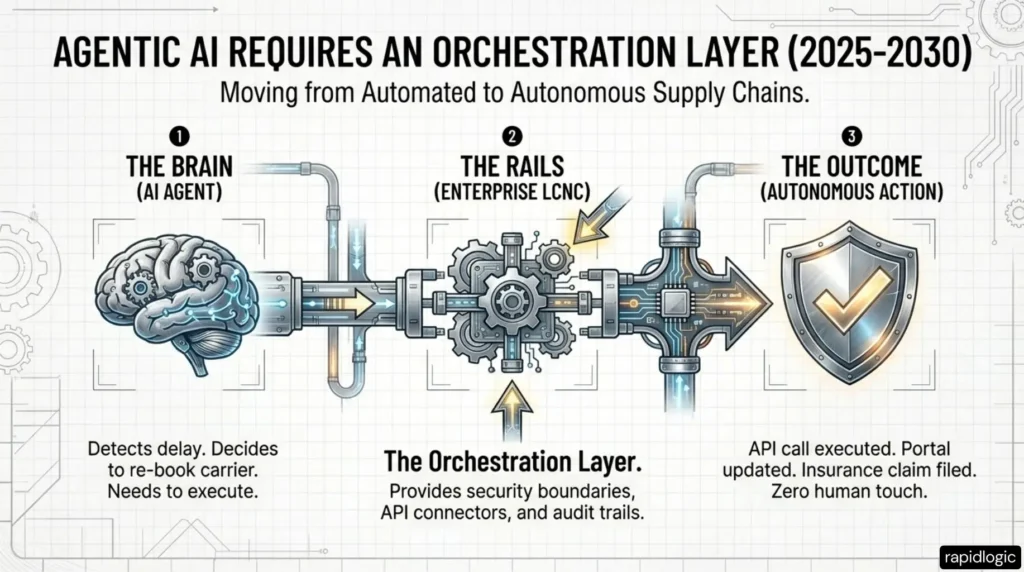
The trajectory of LCNC in TSL is converging with the AI revolution. McKinsey’s Technology Trends Outlook 2025 identifies Agentic AI as the next frontier of automation. In logistics, this means: an AI agent detects a weather delay, autonomously re-books the carrier on an alternative route, updates the customer through the portal, and files an insurance delay claim – with zero human intervention. The LCNC platform provides the rails on which the agent operates: integration connectors, security policies, and audit trails – ensuring AI acts within controlled boundaries.
5.3 Five Strategic Recommendations for TSL Leaders
- Adopt a ‘Hollow Core’ Architecture: do not attempt to rip and replace legacy WMS/TMS immediately. Instead, use LCNC to wrap and extend these systems, building the innovation layer around the stable transactional core.
- Establish a Governance CoE Immediately: LCNC proliferation without governance generates unmanageable technical debt and security vulnerabilities. Define standards and guardrails before scaling.
- Leverage the Talent Multiplier: empower operations staff – who understand the business problems best – to solve their own ‘last mile’ process challenges. Professional developers build the reusable components; citizen developers assemble them.
- Invest in AI-Ready Platforms: select LCNC platforms that are leaders in AI integration (Mendix, OutSystems, Microsoft Power Platform). The next efficiency wave will come from Agentic AI, and your development platform must be the orchestration engine.
- Prioritize Resilience by Design: for every digital project, ask: how quickly can this system adapt if the Suez Canal closes tomorrow? If the answer is ‘months,’ the architecture is wrong. LCNC enables the answer to be ‘days.’
Video Summary
Download materials
PDF full report
PDF slide deck
MP4 video
Ready to calculate the ROI of LCNC for your organization?
Consult your digital resilience strategy with the RapidLogic team. Complimentary strategy session + individualized TCO and ROI analysis for your specific case.