← All case studies
RapidLogic in-house project
Logistics / Municipal services · Two-sided marketplace (no-code)

The marketplace that orders a septic pickup before the tank fills up

Over 2 million homes in Poland rely on septic tanks, yet ordering a pickup still means phoning around and asking for a slot. We built a two-sided platform that connects homeowners with septic service companies: a comparison engine with real prices, an availability calendar and an IoT sensor that places the order by itself. The MVP of the whole ecosystem was built in 10 weeks, in 200 hours of work.

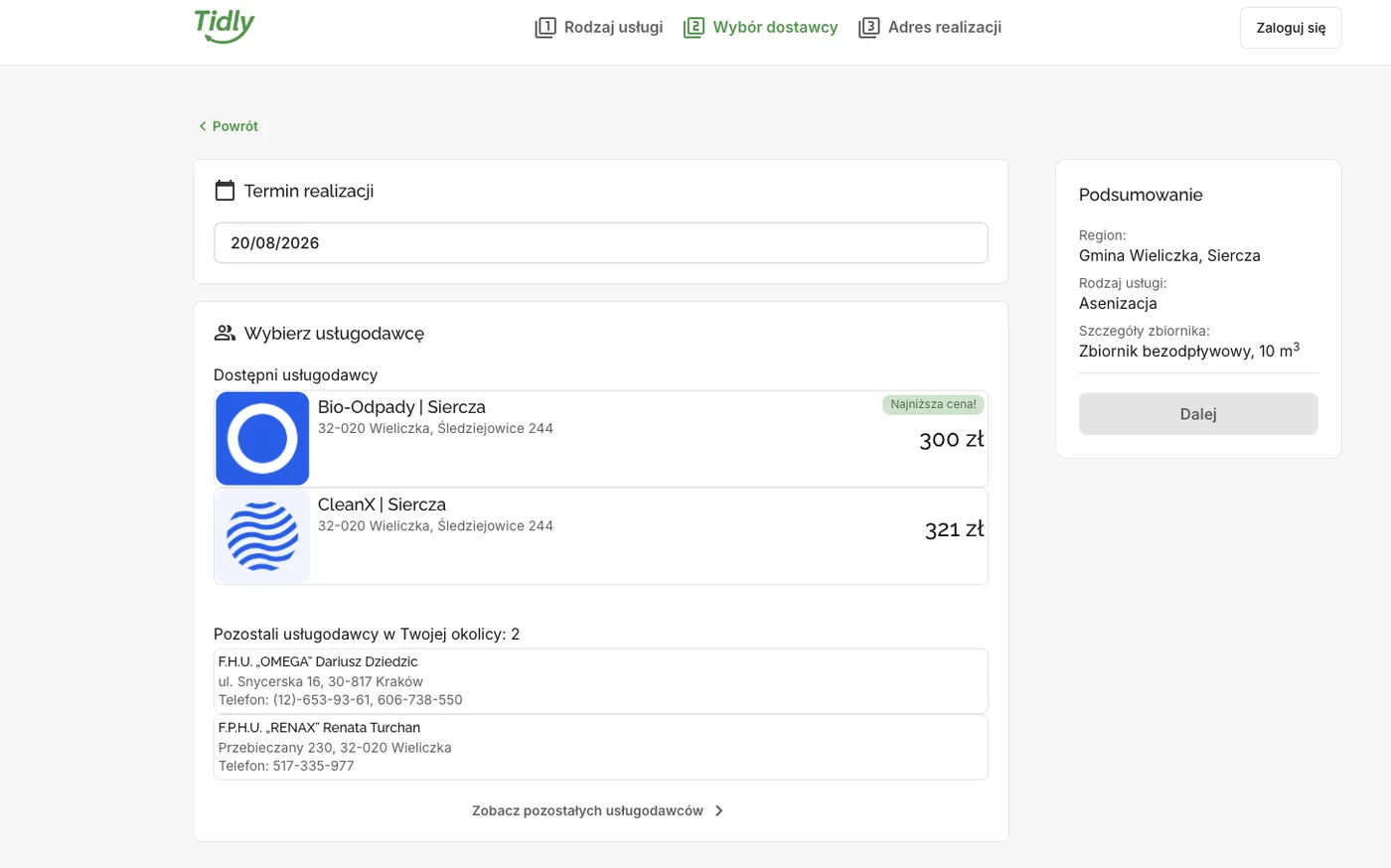
Tidly Marketplace: a comparison of service providers with pickup prices and a lowest-price badge, next to the order summary
10 wks
From idea to a test MVP
200 h
Total effort
2
Sides of the market on one platform
0
Phone calls to place an order

A problem we knew from our own backyard

Tidly is a RapidLogic in-house project and it grew out of the personal experience of our founder, who lives in a house with a septic tank himself. Ordering a pickup looked the same every time: a phone call to the company, a question about the date, an answer along the lines of we may come, we may not, and in winter an extra request for photos of the driveway. A service that should be ordered like an Uber ride required negotiations over the phone.

Market research showed this is not a niche problem. According to data from Statistics Poland (GUS), more than 2 million septic tanks operate in Poland, and the number is not falling, because sewer network expansion cannot keep up with new housing, especially in suburban and mountainous areas. On the other side of the market stand septic service companies, which around Krakow often run 5 to 10 trucks, yet still work on a phone, a notebook and cash.

We decided to build a platform that serves both sides at once: homeowners get an order without a single phone call, and companies get an organised stream of jobs. This entry describes the heart of the ecosystem, the marketplace. The company panels and the customer and driver apps are covered in separate case studies.

A market where both sides lose

On the customer side the problem is not the price but the shape of the service. A suburban homeowner will happily pay a little more, yet wants to order a pickup the way they order food or a ride: in an app, with a visible price and date. On the company side the problem is operational chaos: phone calls from dawn to late evening, prices set in conversation, cash settlements and zero visibility online.

How ordering a pickup used to work

  • Calling local companies one by one and asking for a free slot
  • A price quoted over the phone, with no way to compare offers
  • Extra questions about the driveway in winter, including requests to send photos
  • Cash settlement at the gate, often without a document
  • The risk of an overflowing tank when the pickup came to mind too late

How it works in Tidly

  • An order placed in the browser, in three steps, without a single phone call
  • Real prices from companies available in your town on the chosen day
  • Access notes and road condition photos added once, in the address profile
  • Online payment, cash or bank transfer, always with a document in the archive
  • An IoT sensor that watches the level and places the order by itself

A marketplace built around one rule: zero phone calls

We packed the whole ordering process into a three-step wizard: service type, provider selection, service address. It looks simple, yet underneath runs the most complex part of the platform: a dynamic form that adds data dependent on previous choices at every step. This logic turned out to be the hardest part of the entire build.

Step one: a service matched to the tank, not to a price list

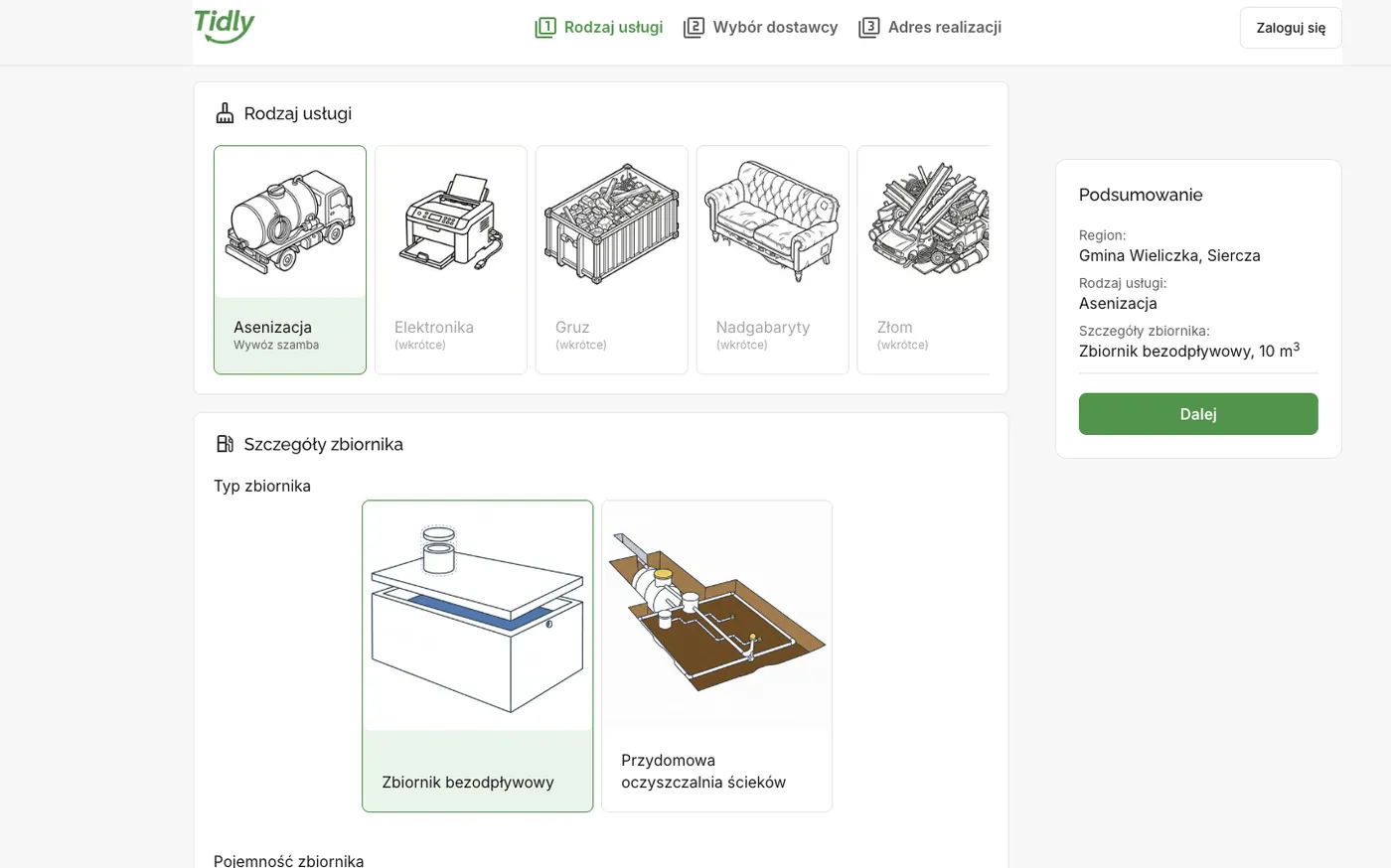
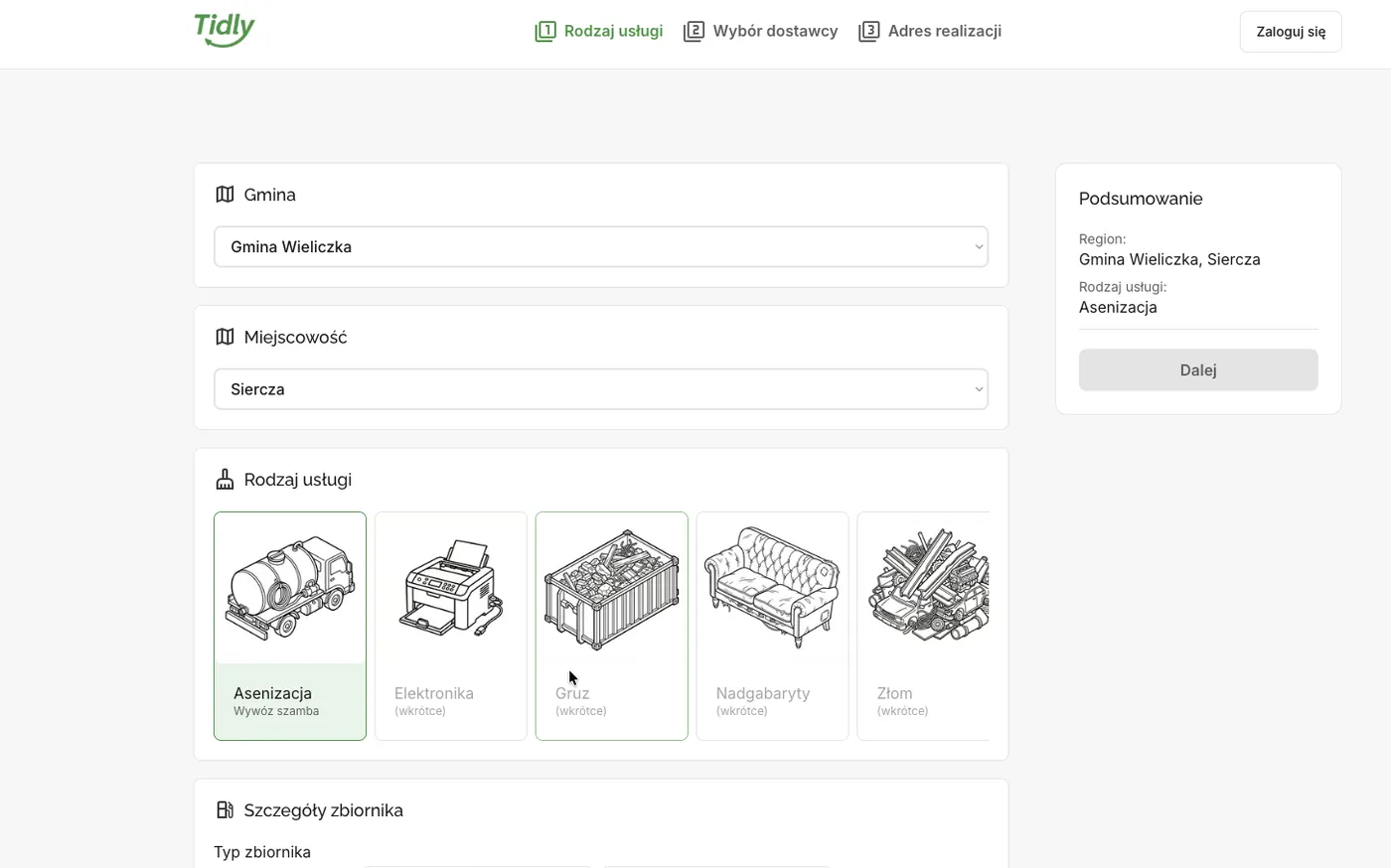
The customer picks a municipality and a town, then the type of service. The platform was designed from day one to go beyond septic services alone, which is why the wizard already shows further waste categories ready to be switched on: electronics, rubble, bulky waste and scrap metal.

The first step of the Tidly order wizard: selecting a municipality, a town and the service type from waste category tiles

The wizard leads from location to service. Septic pickups are live, further waste categories await activation.

Next, the customer describes their tank: type and capacity. This information is key, because all pricing in Tidly is based on tank size rather than on cubic metres of collected waste. The price for a 5 m³ tank already includes travel and the service itself, so the customer knows the full amount before ordering, with no surcharges and no surprises.

Tank type selection in Tidly: a septic tank or a domestic sewage treatment plant, with the summary on the right

Tank type and capacity are set once. The summary on the right grows with every step of the wizard.

The price matrix: pricing the way companies really calculate it

The most important design decision of the marketplace concerned the pricing model. Instead of one flat rate per service, each company builds a matrix in the system: it adds the municipalities and towns it serves, and for every town it enters prices for specific tank sizes. This model mirrors how the industry really works, because the cost of a run depends above all on the distance between the town and the treatment station where the waste is delivered.

As a result, when the customer picks a town and a date, the calendar shows only the companies genuinely available on that day, with ready prices computed from the matrix. The decision is made on real offers, not guesswork. The system additionally highlights the best offer, and next to platform companies it also lists the other providers operating in the area.

Why this works commercially for both sides. The customer gets a comparison engine familiar from hotel booking. The company gets a sales channel where it sets the rates for its towns once, and the system sells its services at exactly the prices it chose, with no haggling over the phone.

Step three: an address with a map and details nobody has to ask about

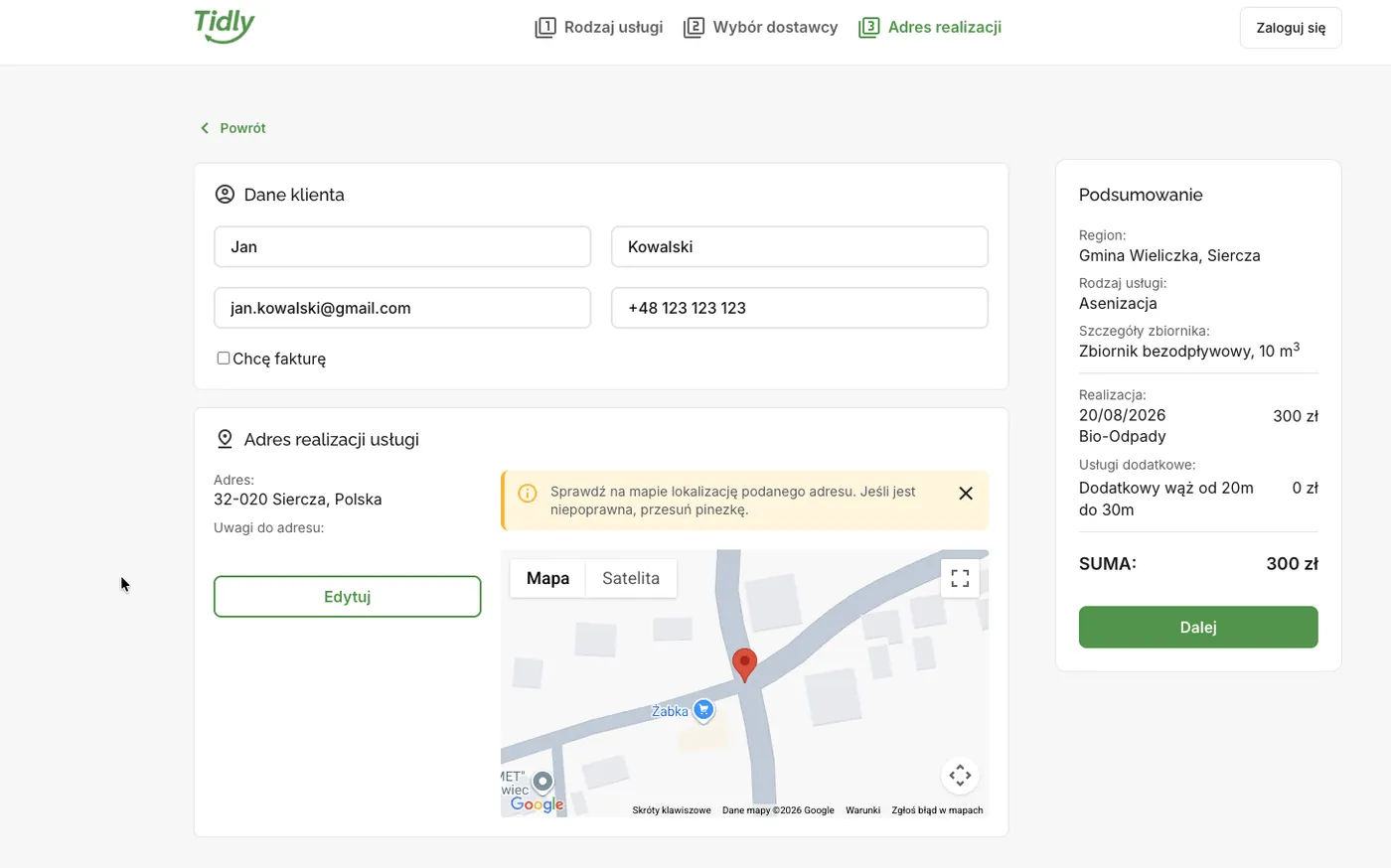
In the final step the customer enters their details and the service address. Under the hood runs the Google Places API together with a map where the pin can be adjusted, so the driver arrives at the right gate without calling to ask for directions. This is also where the customer picks extra services, for example a longer hose when the tank sits far from the road.

The third step of the Tidly wizard: customer details, the service address with a map and the order summary with an extra service

The adjustable pin saves the driver from getting lost and the customer from a phone call about directions. The wizard shows sample data.

Checkout: discounts, guest accounts and three payment methods

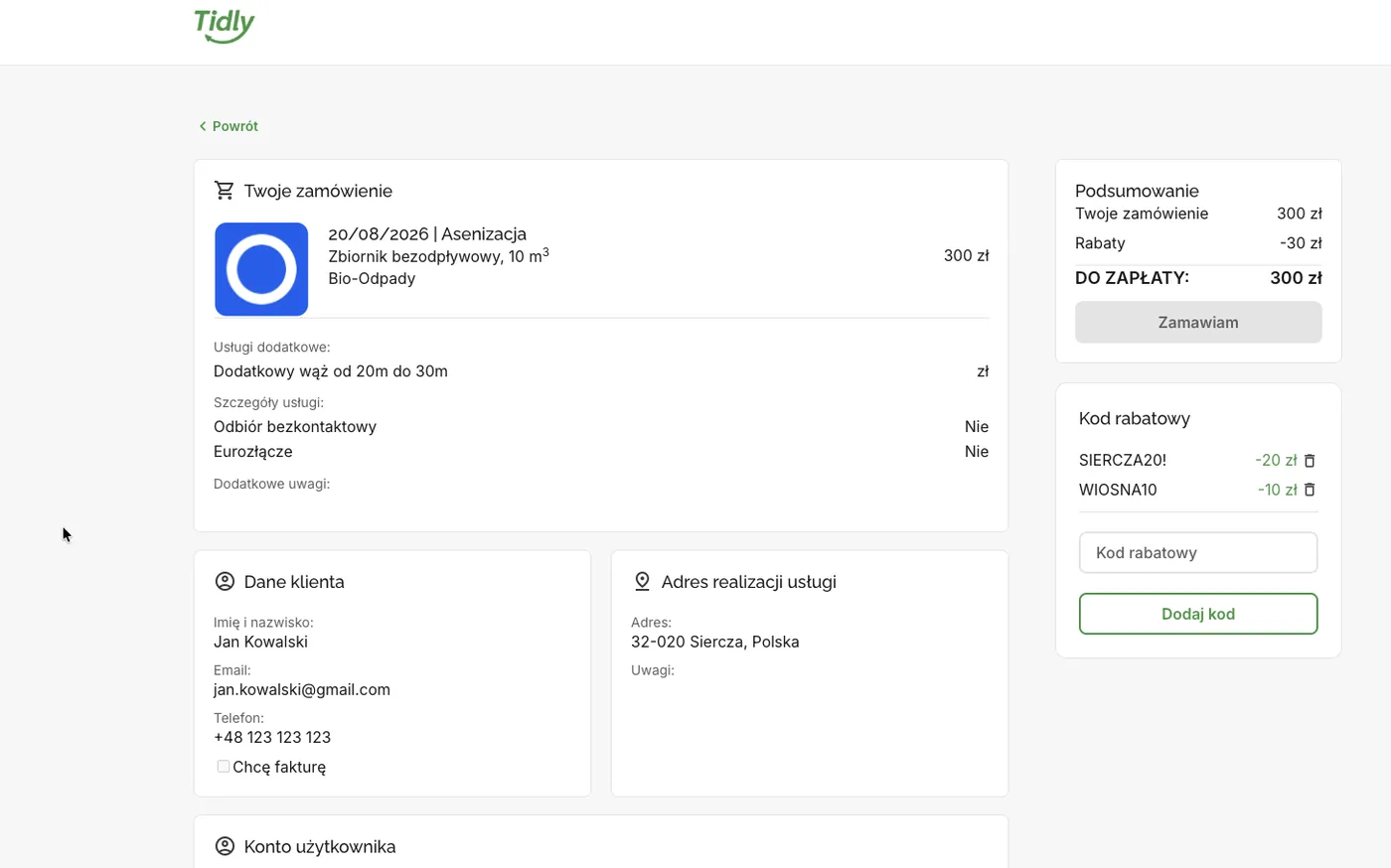
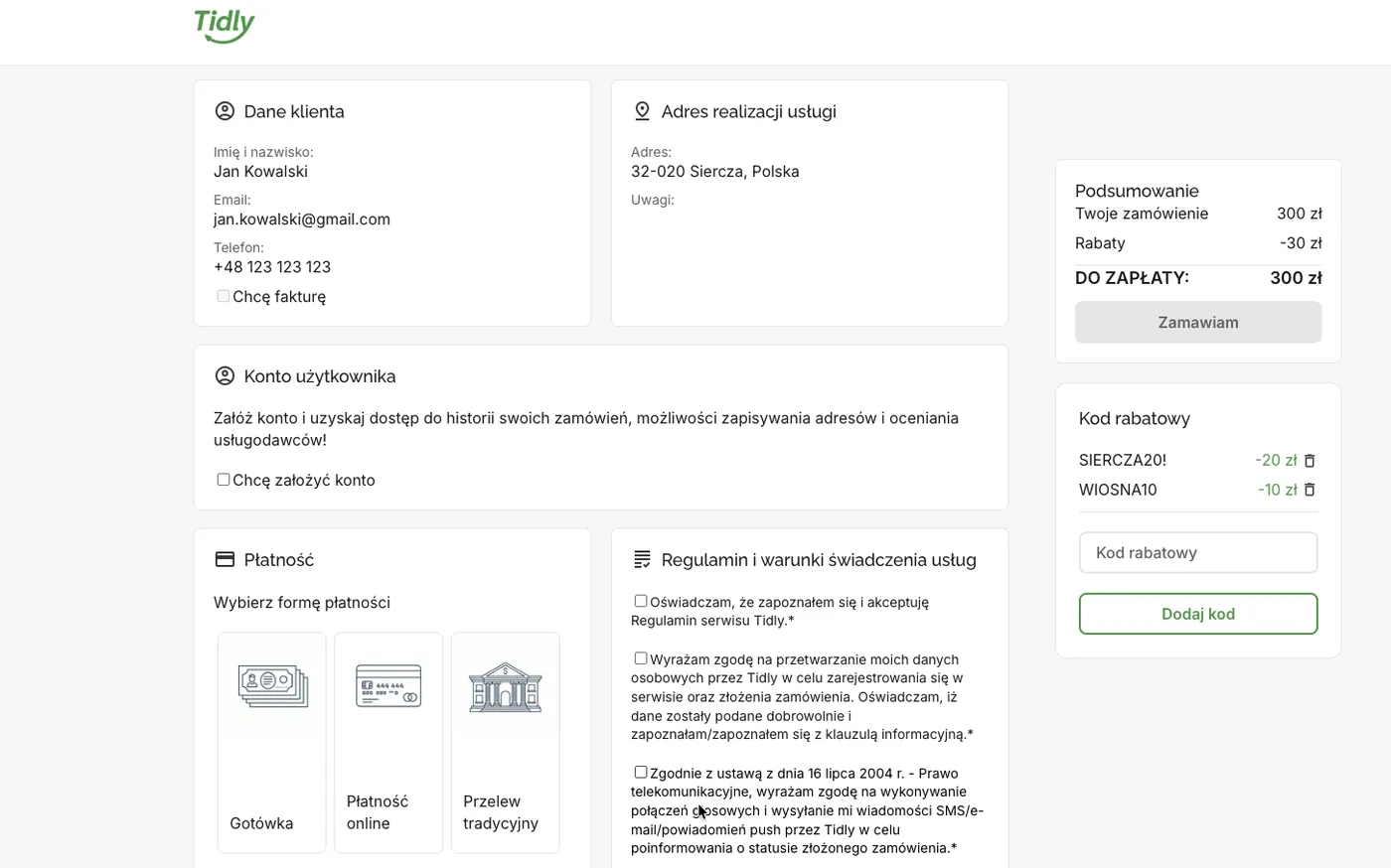
The order summary gathers every decision in one view: the service, the date, the provider, extra services and details such as contactless collection through a Euro quick-coupling. A system of stackable discount codes is in place. An order can be placed without creating an account, because the first contact with the platform should not require registration. An account adds order history, saved addresses and provider ratings.

The order summary in Tidly: order items, service details and a discount code panel with two active codes

The summary with discount codes. Service details include contactless collection and the Euro coupling.

Order checkout in Tidly: an optional user account, payment method selection and the required consents

Cash, online payment or a traditional bank transfer. The order also goes through without an account.

Sensor-driven automation: the moment the platform clicked

The biggest breakthrough of the project came after integrating a liquid level sensor, a physical device installed in the tank that connects over Wi-Fi and exposes an open API (we used a sensor from mojdomek.eu). Tidly reads the actual fill level from it and shows it in the app, so nobody ever has to look under the manhole cover.

On this foundation we built full automation. The customer sets a threshold, for example 80 percent full, picks preferred days and a company selection rule: the cheapest offer or a preferred provider. When the sensor reports the threshold, the system places the order by itself and can charge the card automatically, while the customer only receives a notification that the service has been booked. If the tank has a Euro quick-coupling routed to the fence, the driver performs the collection contactlessly, without entering the property. The whole loop looks like this:

A diagram of a septic tank with a sensor and a marked 80 percent fill threshold
1. The sensor keeps watch around the clock

A wireless device inside the tank monitors the waste level continuously. When it reaches the set limit, for example 80 percent, the sensor sends a silent signal to the system. No peeking under the cover, no guessing.

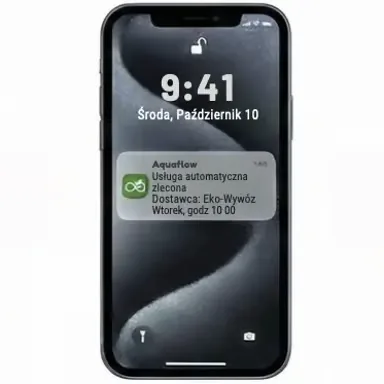
A phone with a notification about an automatically booked pickup, including the provider name and the date
2. The system places the order

You do not have to remember anything. When the signal arrives from the sensor, the system creates a job with the cheapest or your preferred provider. It happens in the background, with no phone calls and no effort on your side.

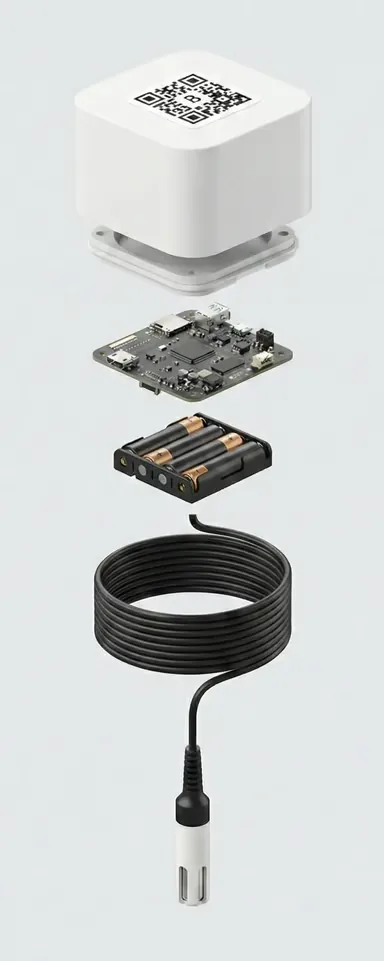
A tank liquid level sensor: the enclosure with a QR code, the electronics board, the battery pack and the cable with a measuring probe
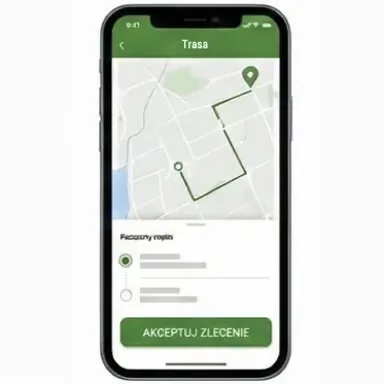
A driver's phone with the route on a map and a job acceptance button
3. The driver taps and drives

The selected company receives a ready job on the phone. The driver accepts it with one tap, arrives and empties the tank. If you have a Euro coupling in the fence, you will not even notice the visit.

A shield icon with a PDF document and a payment card symbolising automatic payment and invoicing
4. Payment and full compliance

The system automatically charges the connected card and sends the invoice to your e-mail. You get an empty tank and paperwork in order in case of a municipal inspection.

You never have to think about your septic tank again. This sentence became the axis of the whole product. A homeowner can literally forget the tank exists: the sensor watches the level, the system orders, the driver collects and the invoice lands in a digital archive.

The other side of the mirror: where the marketplace gets its data

The marketplace does not operate in a vacuum. Prices, calendars and job statuses come from the provider panel, where the company manages price lists, trucks and drivers, while drivers work on a mobile PWA with a job list and navigation. Both parts of the ecosystem were built in parallel with the marketplace, because they are connected vessels, and we cover them in a separate case study.

The platform's business model assumed a commission of 10 to 15 percent on completed services, paid only for successful jobs. In the test phase online payments were not yet connected, but the architecture was prepared for a Stripe gateway with automatic revenue splitting between the platform and the septic service company.
10 weeks, 20 hours a week

The entire Tidly ecosystem was built in roughly 200 hours of one person’s work, carried out alongside other duties at a pace of about 20 hours a week. The marketplace was the main stream of that work, because the remaining components exist so that it can function.

September 2025
Analysis and technical design
Market research, wireframes in Balsamiq, first screen mockups in Figma and the data structure design: companies, towns, price matrices, tanks and orders.
Autumn 2025
Building the ecosystem in Bubble
Parallel construction of connected vessels: the marketplace with its three-step wizard, the provider panel with price lists and a calendar, the customer panel and the driver app as a PWA. The dynamic order form consumed the most work.
Turn of the year
Sensor integration and full automation
Connecting the level sensor through its open API and building the automation: a fill threshold, preferred days, a company selection rule and fully automatic ordering without user involvement.
January 2026
Landing pages, materials and the test launch
The tidly.pl site with offers for homeowners and companies, videos and presentations. The platform launched in test mode in the Wieliczka and Niepołomice municipalities.
February 2026
A strategic pause
Promotion put on hold after the discovery of the governmental Aquarius system. We describe the details and the lessons honestly in the epilogue below.

What was built and what it cost

The most interesting numbers in this project concern the ratio of scope to effort. A complete, working two-sided platform ecosystem was built in the time and budget in which a traditional software house would just be finishing its pre-implementation analysis.

200 h
Of one person’s work
10 weeks at a pace of about 20 hours a week
4
Ecosystem components
The marketplace, the company panel, the customer panel and the driver app
$1,250
Tool costs at most
The total cost of the no-code platform and accompanying services ($750-1,250)
2 mln+
Addressable market
Septic tanks operating in Poland according to Statistics Poland (GUS)

The project bill against a software house quote

The reference point is not theoretical. The quote comes from the software house our founder co-created, so we know what this scope would cost in the classic model.

ItemAmount
Tools (the no-code platform and services)$750-1,250
Own work: 200 hours at a $50 rateabout $10,000
Total cost of building Tidlyunder $11,250

The same scope at a traditional software house: $25,000 to $37,500. A two-sided platform with transactional logic, price matrices, calendars and IoT integration is a project that takes quarters in the traditional model. Here it was built in 10 weeks, after hours.

Why the platform is on a strategic pause today

Case studies usually end with fanfare. We will end this one honestly, because the lessons from this project are just as valuable as the platform itself.

Only after Tidly was built did it turn out that many municipalities and treatment stations were being equipped, top-down, with the governmental Aquarius system, which covers a large part of the functionality designed into Tidly. The requirement to document the full waste cycle stems from EU regulation, so a system rolled out administratively holds a position that is hard to compete with commercially. Importantly, careful market research had not detected it, because the vendor of the governmental system did not position itself for any septic service search phrases at all. A competitor can be invisible in the search engine and still be enormous.

The decision was pragmatic: we pause promotion, the platform stays live in its test phase, and we watch what niche the governmental system leaves as it develops. The product and its entire transactional logic are ready to be relaunched once market space appears.

The most important lesson: the market was validated for a fraction of the price. In the classic model this same story would have ended as a legendary failure with $25,000 to $37,500 burned at a software house. Agile software delivery made it possible to run a full market test, with a working product in users’ hands, for a fraction of that amount. If an initiative does not take off, you simply move on to the next one. That is the key takeaway from this story.

The second lesson concerns research itself: market validation does not end with the competitors visible in Google. It is worth checking the regulatory environment and administratively deployed systems as well, before investing in promotion. Tidly’s technology proved itself in practice, and what stopped further investment was market analysis, not the platform’s capabilities.

Finally, a look ahead. Tidly was built in no-code, in 200 hours of work. The same scope built with AI-assisted engineering, the method we show in the Fortress and Invoice Automation case studies, would have taken roughly three times less time and money. The cost of testing a business idea with a working product has never been this low.

"

The mere thought of making a phone call about a septic pickup made my stomach turn. So I built a platform where the tank takes care of itself: the sensor watches the level, the system places the order and the driver arrives before you even think about calling.

Krzysztof Gromadzki, founder of RapidLogic
Krzysztof Gromadzki Founder of RapidLogic, creator of Tidly

Planning a platform or a marketplace?

Transactional logic, price lists, calendars, payments and device integrations are the elements we built in Tidly from scratch. If your company needs a similar platform, a free digital audit will show how fast and at what cost it can be built.

Book a free digital audit
See all case studies